For Victorian, Edwardian & inter-war homes
A millimetres-thin insulation coating developed for solid-wall homes where insulation boards and cladding aren't viable.
Solid walls are often the biggest weakness left. No cavity. No insulation.
Heat Halo changes how those walls perform — so rooms warm faster and stay warmer for longer.
The Problem
If your home was built before 1939, the chances are your walls are solid — no cavity, no insulation. That's the largest unsolved problem in your house.
It shows up as cold walls even with the heating on, condensation in corners, black mould behind furniture, an EPC stuck in D–F, and money spent heating air that escapes straight through the brick.
The traditional insulation solutions don't help much.
Changes how your home looks — most Planning Officers won't allow it on a period property.
Eat 3–11 m² of floor space, require removing skirting, moving sockets, rebuilding window reveals, and moving the family out for weeks.
Sound easy but rarely deliver measurable results. That's why they have a well-earned reputation problem.
So most homeowners do nothing. And pay for it every winter.
Heat Halo can help improve your EPC rating — increasingly important for property value and future saleability.
Independent Performance Evidence
Heat Halo has been independently evaluated under BS EN ISO 9869 using treated and untreated rooms on the same solid-wall property.
Because Heat Halo adds thermal resistance rather than delivering a fixed percentage outcome, colder solid walls that lose more heat to begin with typically benefit more than the independently tested baseline wall.
See the independent test methodology →
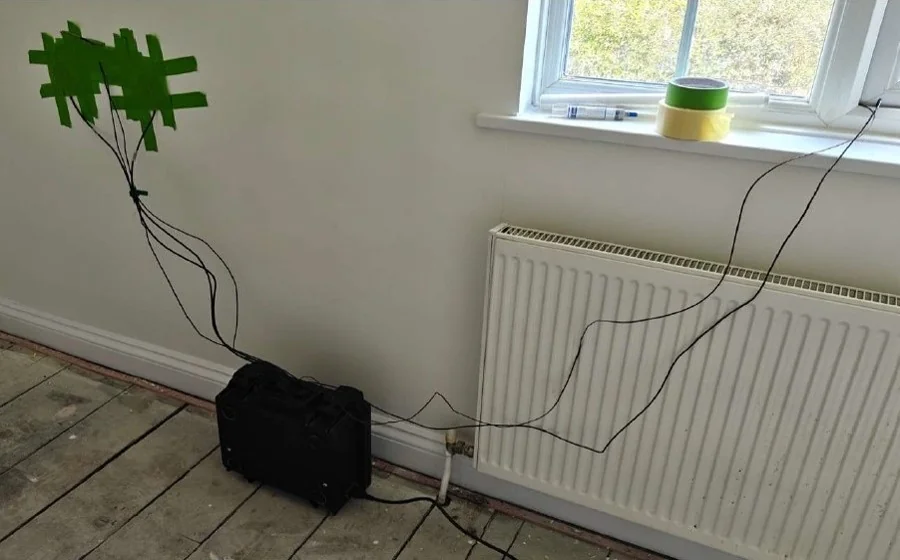
Independently tested under BS EN ISO 9869 in a live occupied property. See the full methodology →
A quick suitability check tells you if Heat Halo is the right answer.
How it works
A specialist thin wall insulation system — not a painted-on shortcut.
Heat Halo is a professionally installed thin wall insulation system designed specifically for older solid-wall homes.
At just 2mm thick, it helps improve wall surface temperatures without the disruption, floor space loss and bulky build-ups associated with traditional internal wall insulation systems.
The result is a wall that looks, feels and functions like any other wall in your home. Pictures, shelves, radiators and decorations can all be fitted as normal.
Heat Halo is also vapour-permeable, allowing solid walls to breathe as they were originally designed to. This is particularly important in older properties, where trapping moisture within the wall can contribute to condensation, damp and mould problems over time.
Optional plastering, decorating and finishing packages are available where required.
Heat Halo is not a retail thermal paint. It is a professionally installed internal insulation system with controlled application, finishing and documented QA on every surface.
How much room does insulation use?
Why cold walls cause mould — and how Heat Halo solves it
What it costs
Prices shown are for the Heat Halo thermal treatment installation. Optional plastering, decorating and finishing packages are available where required.
Unlike conventional internal insulation systems, there are no thick insulation boards, no loss of valuable floor space and no need to rebuild window reveals throughout the property.
Final pricing depends on survey findings, wall area and property layout. Every quote is fixed following a detailed survey — no estimates, no hidden extras and no surprise costs partway through the project.
| Property Type | Typical Scope | Indicative Range |
|---|---|---|
| Terraced House | Thermal treatment of external walls from within the home | £12,000–£16,000 |
| Semi-Detached House | Thermal treatment of external walls throughout the property | £17,000–£22,000 |
| Detached House | Thermal treatment of external walls across all elevations | £23,000–£30,000 |
Already planning to redecorate?
Many customers choose Heat Halo during wider refurbishment projects, allowing thermal improvements to be completed while plastering and decorating work is already planned. This can make excellent commercial sense — one programme, one disruption.
The Heat Halo thermal treatment is typically completed within a matter of days. Where optional plastering, decorating or finishing packages are selected, project durations will increase accordingly. Most homeowners remain in occupation throughout the works.
1–2 days
Rooms fully protected, surfaces prepared and installation areas masked.
1–2 days
Wall surfaces assessed and prepared to the required standard prior to application.
2–4 days
Professional multi-coat spray application by trained specialist contractors.
1 day
Per-surface QA documentation completed and installation signed off.
Included in every Heat Halo installation
Optional finishing packages
Many customers already have their own decorator, refurbishment plans or preferred contractors. Heat Halo can provide a complete finishing package, or leave the treated surfaces ready for your chosen contractor.
The Heat Halo thermal treatment itself is typically completed within a matter of days. Where optional plastering, decorating or finishing packages are selected, typical project durations are: terraced homes approximately 1–2 weeks; semi-detached homes approximately 2 weeks; detached homes approximately 2–3 weeks. Timescales depend on property size, wall area and the finishing options selected.
For a full cost breakdown — what affects the price, how it compares to boards and external insulation, and the replastering comparison — see the Cost Guide →
Is your home a fit?
Homes built before around 1920 are typically solid-wall construction. If your external walls feel cold to the touch or are relatively thin compared with modern cavity walls, Heat Halo may be a strong fit.
Common questions
No. Heat Halo is an installed, multi-coat thermal system applied by trained specialist contractors and finished with a plaster skim.
The base material uses ceramic microspheres, but the performance claim belongs to the installed system — the assessment, masking, application standard, controlled film thickness, and skim finish. It is not a DIY thermal paint and isn't pretending to be one.
The opposite. Heat Halo is vapour-permeable, so moisture can move through the wall the way it always has.
Solid-wall homes are designed to let moisture pass through. The wrong insulation traps it in the brick, leading to damp and black mould.
Heat Halo doesn't seal the wall — it allows it to breathe.
Almost never. We work through the home in stages so you always have unaffected rooms to use. The thermal treatment itself is completed within a matter of days; where optional finishing packages are selected, typical programmes run from 1–2 weeks for terraced homes to 2–3 weeks for detached properties. We'll walk through the programme with you at survey stage so you know exactly what to expect.
Yes, if required.
Many customers already have their own decorator, refurbishment plans or preferred contractors. Heat Halo can provide a complete finishing package including plastering, decoration and making-good works, or we can leave the treated surfaces ready for your chosen contractor.
This allows customers to choose the level of finishing that best suits their project and budget.
Yes — it contributes toward improving your EPC rating.
In solid-wall homes where loft insulation and modern windows are already in place, the walls are often the last major source of heat loss. Improving their performance can support a move from D to C.
The exact impact depends on the property and the assessor's methodology.
The independently measured figure is 16%, tested over 18 days. The improvement is fixed in thermal resistance terms, so the worse your wall's starting performance, the greater the percentage gain — typical solid-walls with a U-value of 2.0 W/m²K can expect around 25%. We'll give you a more specific estimate after surveying your property.
Every Heat Halo installation is covered by a 10-year installation-backed system guarantee, covering defects in the installed coating system and associated plaster finish when installed by approved Heat Halo contractors and used as specified.
The guarantee applies to the system as professionally installed — which is part of why Heat Halo is only available through approved installation, never as a DIY product.
Prices shown are for the Heat Halo thermal treatment installation. Terraced houses typically range from £12,000–£16,000, semi-detached homes £17,000–£22,000, and detached homes £23,000–£30,000. Optional plastering, decorating and finishing packages are available where required. Every quote is fixed following a detailed survey — final pricing depends on survey findings, wall area and property layout.
More questions? View our full FAQ →
Delivered by Heat Halo — specialists in solid-wall insulation
Sixty-second suitability check. We come back within two working days.
Or speak to us directly: surveys@heathalo.uk